
Transgene conçoit et développe
des immunothérapies innovantes
contre le cancer
Des technologies
innovantes
Repousser les limites de l’immunothérapie
Transgene associe des technologies de pointe, une équipe pluridisciplinaire et un réseau international prestigieux.
Découvrez nos deux approches thérapeutiques
Découvrez nos approches innovantes

Un cancer, un patient, un vaccin
Avec myvac®, Transgene entre dans le domaine de l’immunothérapie individualisée. Ces produits stimulent le système immunitaire pour reconnaître et détruire les tumeurs en utilisant leurs propres mutations génétiques.
myvac® en image Découvrez myvac®
Retrouvez les nouvelles données cliniques prometteuses du vaccin individualisé TG4050 présentées lors de l’AACR 2024 par le Dr Alessandro Riva, PDG de Transgene

Nouvelle génération de virus oncolytiques
La plateforme Invir.IO® permet de concevoir une nouvelle génération d’immunothérapie capable d’attaquer directement et sélectivement les tumeurs.
invir.IO® en image Découvrez invir.IO®
TG4001
Vaccin thérapeutique en Phase II
TG4001 cible les cancers anogénitaux induits par le virus du papillome humain (HPV).
Plus d’information
Transgene et NEC présentent la preuve de principe de TG4050 dans les cancers de la tête et du cou 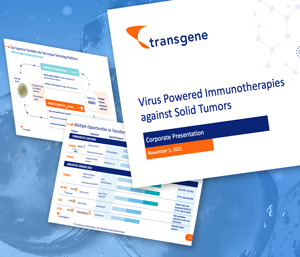
Présentation corporate

AACR 2024
Télécharger le communiqué de presse (PDF)
Interview d’Alessandro Riva
Télécharger le poster (PDF)
Communiqués de presse
- 24 avril 2024 - Mise à disposition des documents préparatoires à l’Assemblée générale du 15 mai 2024
- 11 avril 2024 - Mise à disposition du document d’enregistrement universel 2023 de Transgene
- 9 avril 2024 - Transgene et NEC présentent les premières données cliniques de leur vaccin individualisé contre le cancer, TG4050, dans les cancers de la tête et du cou à l’AACR 2024
- 27 mars 2024 - Transgene prévoit des avancées significatives sur son portefeuille d’immunothérapie en 2024 et étend sa visibilité financière jusqu’au 4ème trimestre 2025
Dernières publications
- 9 avril 2024 - Personalized vaccine TG4050 induces polyepitopic immune responses against private neoantigens in resected HPV negative head and neck cancers
- 29 août 2023 - Phase Ib/II trial of tipapkinogene sovacivec (TG4001), a therapeutic human papillomavirus 16-vaccine, in combination with avelumab in patients with advanced human papillomavirus 16-positive cancers
- 26 mai 2023 - Safety and Immunogenicity of TG4050; a personalized cancer vaccine in head and neck carcinoma
- 26 mai 2023 - Immunogenicity and clinical activity of Tipapkinogen sovacivec (TG4001), an HPV-16 cancer vaccine: a randomized phase 2 study in recurrent or metastatic (R/M) anogenital cancers
- 16 avril 2023 - TG6050 an oncolytic vaccinia virus armed with interleukin 12 and anti-CTLA4 antibody induces TME remodeling and strong anti-tumoral responses
- 11 septembre 2022 - Updated data of biodistribution and activity of oncolytic virus TG6002 after intravenous administration in patients with advanced gastrointestinal carcinomas
- 19 janvier 2022 - Vectorized Treg-depleting αCTLA-4 elicits antigen cross-presentation and CD8+ T cell immunity to reject « cold » tumors
- 22 juin 2020 - Performance of neoantigen prediction for the design of TG4050, a patient specific neoantigen cancer vaccine